Originally Published as: No Stars In Stripes: Industry experts share their thoughts on preventing tiger striping
Gutter Opportunities: Spring 2006 FLASHBACK
This article was originally published in the Spring 2006 edition of Gutter Opportunities, a supplement to Metal Roofing Magazine. We’re re-publishing it here, as a Flashback article, because it cuts through confusion around a common but often misunderstood gutter issue. By presenting multiple expert viewpoints, the article explains that tiger striping rarely has a single cause and is typically the result of airborne contaminants, roof debris, paint finishes, and environmental conditions working together. This balanced perspective helps readers avoid oversimplified explanations and misplaced blame.
The article also equips contractors with practical insight they can use when talking with homeowners. It clarifies why tiger striping often leads to callbacks, highlights the role of coating quality and color choice, and reinforces the importance of setting realistic expectations about maintenance. Although the article was written years ago, the problem it addresses has not gone away. The causes, challenges, and solutions discussed remain relevant today, making the piece a valuable reference for roofing and gutter professionals looking to reduce callbacks and improve customer communication.

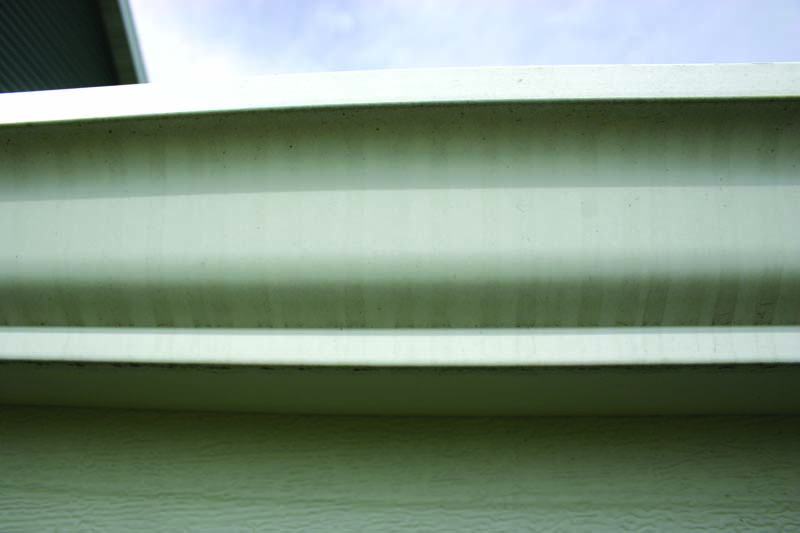
Type in “tiger striping” and “gutters” on an Internet search engine and you’ll come up with some seemingly contradictory theories. Among them:
- Tiger striping is caused by oil leaching out of shingles and from oily pollutants in the air running over the gutters during rain.
- Unsightly stains known as “tiger striping” [are] caused by rainwater and debris dripping down the face of the gutter.
- Excess water [can] run down the front of your gutter and create tiger striping stains.
- Tiger striping [is] common in the gutter industry, particularly with high-gloss white finishes.
- Tiger striping … happens primarily because of the roll form design of some gutter machines … [so that] pollution and dirt continually build up on the top lip of a rain gutter.
- By channeling the water into your gutters and keeping debris out, [gutter] guards help prevent tiger stripes from appearing on the front surface of your gutters.
- The only way we are aware of removing the tiger striping is to use a harsh degreaser and brush and physically scrub the gutters.
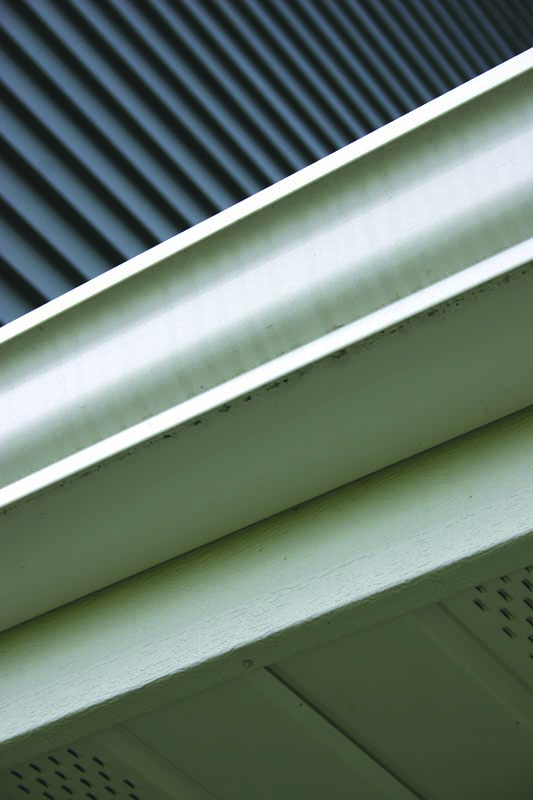
So what causes tiger striping — asphalt oil, leaves and debris, excess water, glossy paint finishes, or a poorly designed gutter lip? And what’s the best way to deal with the problem — using gutters with resistant paint finishes, or those with a properly designed lip? By installing gutter guards to divert debris? Or by scrubbing the gutters with a degreaser?
Ask the experts and, again, some different opinions emerge. “People have different theories about what causes tiger striping,” allows Fred Gutowski, an industry veteran in the specialty sales and service division of Englert Inc., a gutter supplies manufacturer based in Perth Amboy, N.J.
As for Gutowski, “I’ve always thought tiger striping is caused by dirt from the roof that lies on the top lip of the gutter,” he explains. “Especially in the spring when you get a dew, that will make the dirt run down the face of the gutter. I don’t know how you can prevent that from happening.”
Just as homeowners are told they need to periodically wash their vinyl siding, Gutowski believes homeowners should also clean off dirt from their gutters. “It just takes a little pressure and a little brushing,” he suggests. “The same thing happens with your windows. There’s a lot of dirt in the air and so you have to wash them off now and then.” Though Englert offers a 20-year warranty, the document also informs consumers how gutters should be cleaned and maintained.

Gutowski recalls once visiting a homeowner who complained about dirty gutters “and so I just took a hankie, wetted it, and wiped off the gutters.” He concedes that high-gloss white gutters will show dirt more than brown or other darker colors. And though Englert gutters use a paint finish that resists dirt and is formulated for easy cleaning, he adds, “the problem of tiger striping isn’t with the paint, it’s with the dirt when you don’t clean it off.”
Homeowners who fail to deal with dirt, Gutowski says, may find that ultraviolet rays eventually bake the dirt into the gutter surface. In cases where consumers are unable to maintain their gutters, he suggests that gutter companies who provide leaf cleaning services also can clean off dirt from the gutter itself.
At Ryan Seamless Gutter Systems of Westwood, Mass., president Frank Ryan believes tiger striping is “caused by contaminants in the air that eat at the gutter’s paint surface” such as leaves, pine needles, acid rain, pollen, shingle grit, general dirt, and pollutants from a chimney or furnace. In his view, however, the real culprit in tiger striping “is when the gutters don’t have enough paint coating.”
Because the gutter industry is a competitive business, Ryan continues, “Not all manufacturers use the highest quality coatings. After all, consumers don’t demand a high-quality finish like they would on a car.” He notes that gutter manufacturers can add wax into the paint in order to help coil run more smoothly through a seamless gutter machine and across the rollers.
Ryan’s company, which distributes gutter supplies to contractors, sells coil painted with a tough two-step polyester finish. He believes the choice is a good solution at a price homeowners can afford. “Kynar paint finish is the best,” he explains, “but it’s expensive. The gutter market is so competitive that if we marked up our products even 10 percent then we’d price ourselves out of the market.”

Once gutters are installed and exposed to airborne contaminants, what can be done to keep tiger stripes from happening? Ryan agrees that the high-gloss white gutters, favored by large numbers of consumers, can show dirt “and have the most problem with striping.” But he sees a problem in telling a customer that tiger stripes are basically the homeowner’s problem.
“The whole concept in selling somebody a new gutter system,” Ryan points out, “is that the homeowner can buy your product and never have to worry about gutters again. So people buy new gutters with the expectation that they’ll be maintenance-free.”
For that reason, if tiger striping occurs then it’s the gutter contractor who is going to get a phone call. “But I don’t know a single gutter installer,” Ryan notes, “who will go back and re-clean a new gutter when it gets stripes.” That’s one reason why Ryan Seamless Gutter Supply switched to the two-step polyester paint finish. “Tiger striping was an ongoing problem with gutters we used to sell,” he reports, “but now we have a lot fewer call-backs.”
Daniel Hawk, business development and metal marketing manager for Pittsburgh-based Alcoa Home Exteriors, has his own opinion about tiger striping. “It’s caused by airborne dirt and debris that’s sitting on the front lip of the gutter,” he believes. But then he adds that striping “is most prevalent when people replace their asphalt shingles.”
The problem with tiger striping, Hawk continues, is not in the gutter itself. “Roofers start removing asphalt shingles and the paper underlayment,” he explains, “and you kick up a lot of carbon in the air. The dust and debris get on the gutter lip, and when you get a dew then striping occurs.” One answer to tiger striping, therefore, “is for the homeowners to ask the roofer to clean the gutter once the new roof is completed,” he says.
Another answer, Hawk suggests, is to install gutters with a superior paint finish. “Dirt and striping is worst on white, polyester-finish gutters,” he believes. “Some polyester coatings stain a lot. But at Alcoa we use an acrylic waterborne paint system on our sectional gutters which cuts down significantly on tiger striping.”
No matter how you explain it, tiger striping is a problem in the gutter business. But the onus for providing a solution lies with the installer. “It just isn’t practical,” Hawk contends, “for you to recommend to homeowners that they get up on a ladder and clean the gutter lip. A lot of people who replace their gutters are in the older demographic. They’re tired of dealing with gutter problems. So their expectation is, ‘I never want to clean my gutter again!’”
Read more “Flashback” articles online at https://readmetalroofing.com/flashback/.