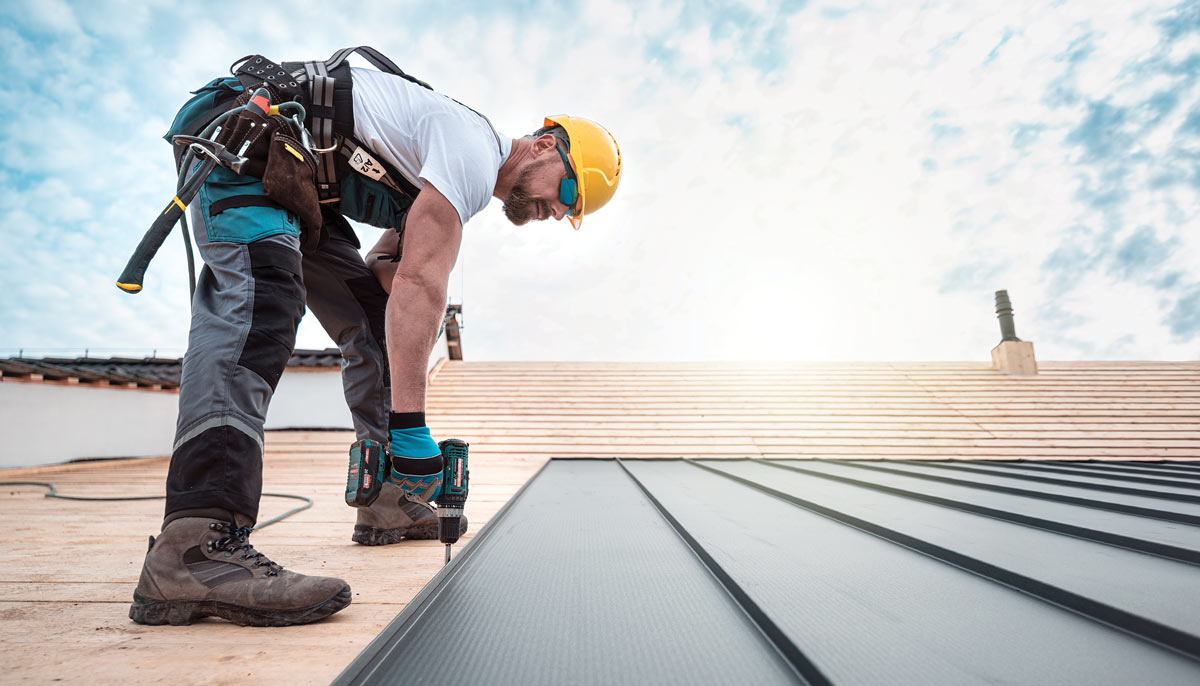
When working with metal roof systems, many decisions and factors come into play. Choosing between plywood and OSB roofing substrates is just one of many considerations. Adjusting thicknesses and grades—along with understanding what your specific building will require based on climate—are other important decisions that need to be handled with care. Doing your research on these choices can make or break a stable building.
Exterior Grade Plywood vs. OSB
When choosing between exterior grade plywood and Oriented Strand Board (OSB) for roof sheathing under metal panels, several factors should be considered. These include cost, moisture resistance, durability, installation, and environmental impact.
Plywood is generally more expensive than OSB. The cost difference can become significant for larger projects. According to the International Association of Certified Home Inspectors, OSB can be manufactured in larger panels than plywood. For a typical 2,400-square-foot home, OSB may cost around $700 less than plywood.
Though more affordable, OSB may not handle moisture as well as plywood. Plywood has superior moisture resistance—it absorbs water faster but dries out much more quickly. This allows it to return to its original dimensions as it dries. OSB, on the other hand, takes longer to dry and is prone to swelling along the edges. This swelling can become permanent and lead to “ghost lines” visible through some roof finishes. Exterior grade plywood is considered more suitable for humid or wet climates.
Plywood also offers greater stability and strength. It shows better resistance to bending, sagging, and impacts. However, OSB provides sufficient strength for most roofing needs. Both plywood and OSB are installed similarly. OSB is available in larger sheets, which can speed up installation.
When comparing the environmental impacts of the two options, OSB is generally more favorable. Plywood requires more intensive harvesting of slower-growing trees, while OSB uses fast-growing trees and maximizes wood usage.
Thicknesses and Grades
A steeper slope may require thicker decking to ensure resistance to wind and other weather-related forces. Stronger decking helps prevent sagging or failure, and it must withstand increased downward and outward loads. Thicker decking helps combat wind, snow, and impact forces.
When it comes to metal roofing material, Michael Ringler of Hixwood pointed out that some manufacturers measure panel thickness after painting, while others measure before painting. It’s a good practice to ask the supplier whether their steel is measured before or after the application of paint.
Local building regulations typically dictate the minimum thicknesses required, based on factors such as roof slope, wind zones, and snow loads. The common thickness for residential and commercial roof plywood is ½ inch, with 5/8 inch being recommended for added strength when installed on a slant or grade. A 7/16-inch OSB panel is the most commonly used thickness for similar buildings.
Ringler recommends that the post-frame industry use at least a 28-gauge, grade 80 steel for roof panels. Because of its hardness, he suggests using this grade for all roofing and siding with exposed fasteners. He further explains that grade 50 steel is softer and more prone to denting or bending, making it better suited for trims or panels requiring extreme bends.
Fastener Pull-Out and Oil Canning
Plywood offers stronger pull-out resistance due to its cross-laminated veneer layers, which provide a better grip for fasteners. Fasteners in plywood perform more consistently, especially when placed near sheet edges. Plywood is particularly effective when using screws or ring-shank nails.
OSB has lower pull-out resistance than plywood, particularly when wet. Under repeated stress or high loads, fasteners can “strip out,” preventing a secure connection. OSB is also more likely to split at the edges and experience fastener blow-through if nails are overdriven or placed too close to the edge.
Oil canning refers to the perceived waviness or distortion of a metal panel. This can happen with any type of metal used in construction. Plywood provides a stiffer, flatter surface that helps resist irregularities. It also undergoes less dimensional movement due to moisture, resulting in a more consistent surface beneath metal panels—helping to reduce oil canning.
In contrast, OSB is more prone to swelling when exposed to moisture. The resulting uneven edges can contribute to oil canning. Even when properly acclimated, OSB can create more visible imperfections in the metal surface.
Purlin Shapes and Spacing
Purlin spacing depends on factors such as panel design, roofing material, load requirements, and building codes. Some professionals recommend a maximum purlin spacing of 24 inches on center. However, with appropriate panel design and stronger purlins, wider spacing may be feasible.
Ringler explains that purlin spacing impacts both walking safety and wind uplift. He would recommend that anything under 4’ O.C. using 2×4 2’ O.C. laying flat. On anything over 4’ O.C. there are several different options you can use, including purlins upright and overlapped using suitable 2x material or purlins dropped in using hangers and suitable 2x material. Some projects recommend the spacing on purlins to be less, such as 1’6” or 1’ O.C.
The type and gauge of metal roofing also determine spacing requirements. Buildings located in areas with snow or severe wind loads will require closer purlin spacing than those in milder climates. Properly spaced and sized purlins allow for efficient load distribution across the roof structure. Always consult local building codes and manufacturer recommendations.
The shape of the purlin also matters because it affects the roof’s structural performance. Purlin shape influences support, stability, attachment points for roofing materials, and spanning capability. Both C- and Z-shaped purlins are commonly used for 24-gauge metal roof panels, chosen for their structural integrity and contribution to the roof’s load-bearing capacity.
Fastening Patterns and Accessories
Specific fastening patterns and accessories are often necessary when roofing directly over rafters or supports without a solid deck. Screws must be driven properly in exposed fastener systems to ensure washers are properly sealed to prevent leaks. In concealed fastener systems such as those used in standing seam roofs, the proper clips and fasteners must be used. Since metal expands and contracts with temperature changes, proper clips (especially floating or sliding types) allow panels to move without buckling or distorting. Using the wrong clip can restrict movement, leading to oil canning, panel warping, or system failure.
In situations with low-strength decking, fastener density may be increased to compensate for reduced pull-out strength.
Fastening accessories include battens or purlins, underlayment, and specialized clips or fasteners. Battens or purlins provide a fastening surface when a solid deck is not present. Underlayment is generally recommended for added weather protection, though not always required. Specific fasteners or clips may be determined by the type of roofing material and installation method.
IBC / IRC
The International Building Code (IBC) for industrial projects includes several relevant sections:
Section 1507: Roof covering material requirements
Section 1504: Performance requirements (e.g., wind uplift resistance)
Section 221: Steel roof decks (fastening, thickness, design)
Section 2304.9: Wood structural panel sheathing (plywood or OSB)
Section 1609: Wind loads
ASCE 7: Structural load calculations and wind uplift pressure zones
The International Residential Code (IRC) also provides reference points for substrate specifications and fastening patterns:
Section R803.1: General requirements for plywood and OSB sheathing
Section R803.2: Thicknesses, span ratings, panel orientation, and fastening
Section R803.3: Structural metal panel sheathing
Section R803.4: Cold-formed steel framing for steel-framed homes
Table R502.3(1): Nailing patterns and common fastening types
Section R301: Design criteria
Section R905: Roof covering requirements
Conclusion
The location, climate, size, and slope of a building can greatly influence the selection of proper decking materials for metal roofs. Understanding the benefits and trade-offs between plywood and OSB, as well as proper purlin shapes and spacing, fastening patterns, and the relevant sections of the IBC and IRC, provides a solid foundation for building a durable, high-performance roof system.