Originally Published as: Strategies for Safer Construction Sites: From Hiring To Insurance
“Construction is one of the most dangerous occupations in America” (Bruce and Turko). Even if you do everything right, there is still a relatively high probability of a workplace accident in this field. Lowering the risks of these accidents starts with the people you hire; how you select them, how you keep them happy, and how you keep them safe.
First, you need to hire the right person — someone who has experience or is easily trainable, has a clear background check, is willing to follow safety protocols and is able to pass a drug test. The hiring process can be taxing and it can be difficult to determine if someone is being truthful. The following are some tips for conducting interviews; pay attention to the interviewee’s eyes, listen for a confident voice, be mindful of rambling and most importantly — trust your gut (Nezich).
Naturally, most people will be nervous during a job interview, a shake in their voice here and there and not having perfect eye contact is expected. But how do you differentiate signs of lying from true nervousness? The Small Business Association of Michigan suggests starting your interview by establishing a baseline (Nezich). Instead of jumping straight into interview questions related to the job, start with a few personal questions. For example, “Where did you grow up?” or “What is your favorite hobby?”
While they are answering these questions, pay attention to their mannerisms. Then, while you are asking job-related questions, you will notice if their mannerisms change, possibly indicating a lie or lack of knowledge on that topic. This would likely be shown through a change in voice control, shifting body position, or variation in eye movement and breathing (Nezich). By having the ability to watch for these changes, you will be able to determine if the candidate is truly experienced in your field.
Once you find a potential candidate, a background check and drug screening should be completed. Construction carries certain inherent risks; if you add drugs or immaturity into the mix, your likelihood of having an accident greatly increases. According to a paper presented at the 2006 ASSE Professional Development Conference and Exposition, peers in the construction sector self-reported drug abuse at 25% or higher (Bruce and Turko). This is compared to 8-10% of workers in all sectors of jobs (Bruce and Turko). If an employee can pass both a background check and a drug screen that is a strong indicator that they are going to be responsible and reliable and reduces the likelihood of drug related accidents on the job.
Now that you have found a great addition to your team, it is important to keep them happy and prevent burnout. The Construction Management Association of America has some helpful tips in this department: hire enough staff, create a positive work environment, focus on safety, provide sufficient training and establish a claims management program (Richer).
With an appropriate work-life balance, your staff will be less likely to call in and will be better rested. Construction is physically demanding and staff can fatigue easily, potentially causing more accidents. By having a well-staffed and supported team, you can avoid overworking your employees. A full team will get the job done faster, more efficiently and safely. This will allow more time off for your team members, encourage positive energy at your work place and reduce the risk of fatigue related accidents. A win-win for everyone.
To keep the positive energy going, you should make your employees feel like they are a part of an organization, instead of feeling like someone who was only hired to take commands. Make them a part of your planning, relay the hows and whys of each construction project, and show them why they are valued. Every employee will have a different skill set; concentrate on their strengths and assign them to the appropriate task. This will make your construction project flow quickly and smoothly. The job of a contractor would be a lot harder without a team willing to work together, so do your best to show your staff you appreciate them. Appreciation can also be shown through keeping your staff safe.
Making safety a priority and providing adequate training are likely the top ways to prevent any accidents. Onboarding training should be stressed with every new hire. Although they may have indicated they are well versed in construction, you never know if they had proper protocols set in place at their last job. Every sector of construction will have differences in their expectations, making it important to emphasize what you want out of your employee. Setting clear and concise expectations will protect your new hire and yourself if they choose to not follow instructions.
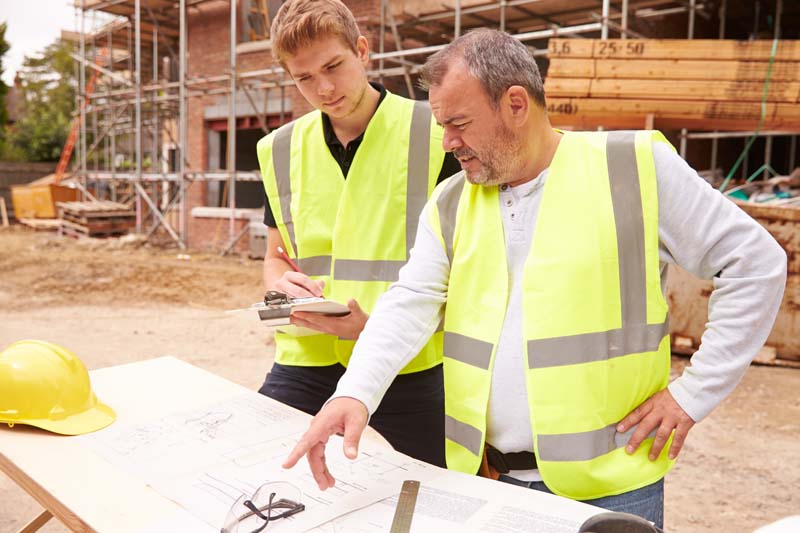
As an employer, you should thoroughly understand the liabilities associated with your work and implement safety protocols such as ensuring your staff have the correct personal protective equipment (hard hats, vests, tie-offs), ensuring clear communication, performing regular checks on all equipment, and taking all incidents seriously to prevent future accidents (Richer). It is also important to keep reminding your staff of your safety protocols, as even the best-trained may get too relaxed and start cutting corners. If you ignore a small incident or accident here and there, your team may learn it is ok to skip steps, resulting in more serious accidents down the line.
Along with safety, you should have sufficient training set up before throwing your new hire into the line up. It is helpful to assign a trusted staff member as the designated trainer. This should be someone who is respected and follows your safety protocols and expectations to a T. If you allow a lazy staff member to train your new staff, you will end up with a lazy and unreliable team. It always starts at the top. Show your staff how serious you are about training and safety and they will eventually keep each other in line on their own.
Lastly, it is helpful to have a claims management program (Richer). If you vocalize expectations frequently and your staff follows direction, hopefully you won’t have to use this program. It is mainly set up to make sure all incidents are taken seriously and staff can feel protected if something did happen to them. If their claims are responded to promptly, and you check in on them frequently after a workplace accident, this will reduce the chance of legal action and increase trust (Richer). If an accident does occur, it is important to have a suitable insurance plan.
According to the Associated Builders and Contractors of Wisconsin the eight must-have insurance types for construction company owners are general liability, professional liability, pollution liability, business vehicle and commercial auto, inland marine, contractor license bonds or surety bonds, workers’ compensation and cyber insurance (Carlson). These are the minimum recommended, depending on your company you may need to cover additional areas. Having these eight main areas will cover you in most instances including injuries or medical expenses, unexpected financial situations, chemical accidents, vehicular accidents, transportation of supplies, licenses or permits, protecting your company and client data and so much more (Carlson). Find a reliable insurance company, review your plan in detail and make sure you understand the ins and outs of it.
Because of the natural risks in the field of construction, some accidents are inevitable. However, as a business owner you have many tools at your disposal to minimize these risks. You can hire a trusted team, implement safety protocols, be aware of your liabilities, have the proper insurance, and maintain a healthy work environment. It is better to be over prepared and responsible than to cut corners; this can set you apart from other companies and provide you with a better team. Protect your business by protecting your team.
Works Cited:
Bruce, Roger, and Steven Turko. Drug Testing in the Construction Industry – A Contractor’s Perspective. ASSE Professional Development Conference and Exposition Proceedings, American Society of Safety Engineers, 2006, onepetro.org/ASSPPDCE/proceedings-abstract/ASSE06/ASSE06/ASSE-06-719E/32834. Accessed 16 Aug. 2025.
Carlson, Troy.8 Must-Have Types of Insurance for Construction Companies. Associated Builders and Contractors – Wisconsin Chapter, n.d., www.abcwi.org/wisconsin-contractor-blog/8-must-have-types-of-insurance-for-construction-companies/. Accessed 16 Aug. 2025.
Nezich, Heather.Lie Detection 101 – How to Spot Lies During the Interview Process. Small Business Association of Michigan, 24 Feb. 2024, www.sbam.org/lie-detection-101-how-to-spot-lies-during-the-interview-process/. Accessed 16 Aug. 2025.
Richer, Michel.Minimizing Workforce-Related Risks on Your Construction Projects. Construction Management Association of America, 2021, www.cmaanet.org/sites/default/files/resource/Minimizing%20Workforce%20Related%20Risks.pdf. Accessed 16 Aug. 2025.