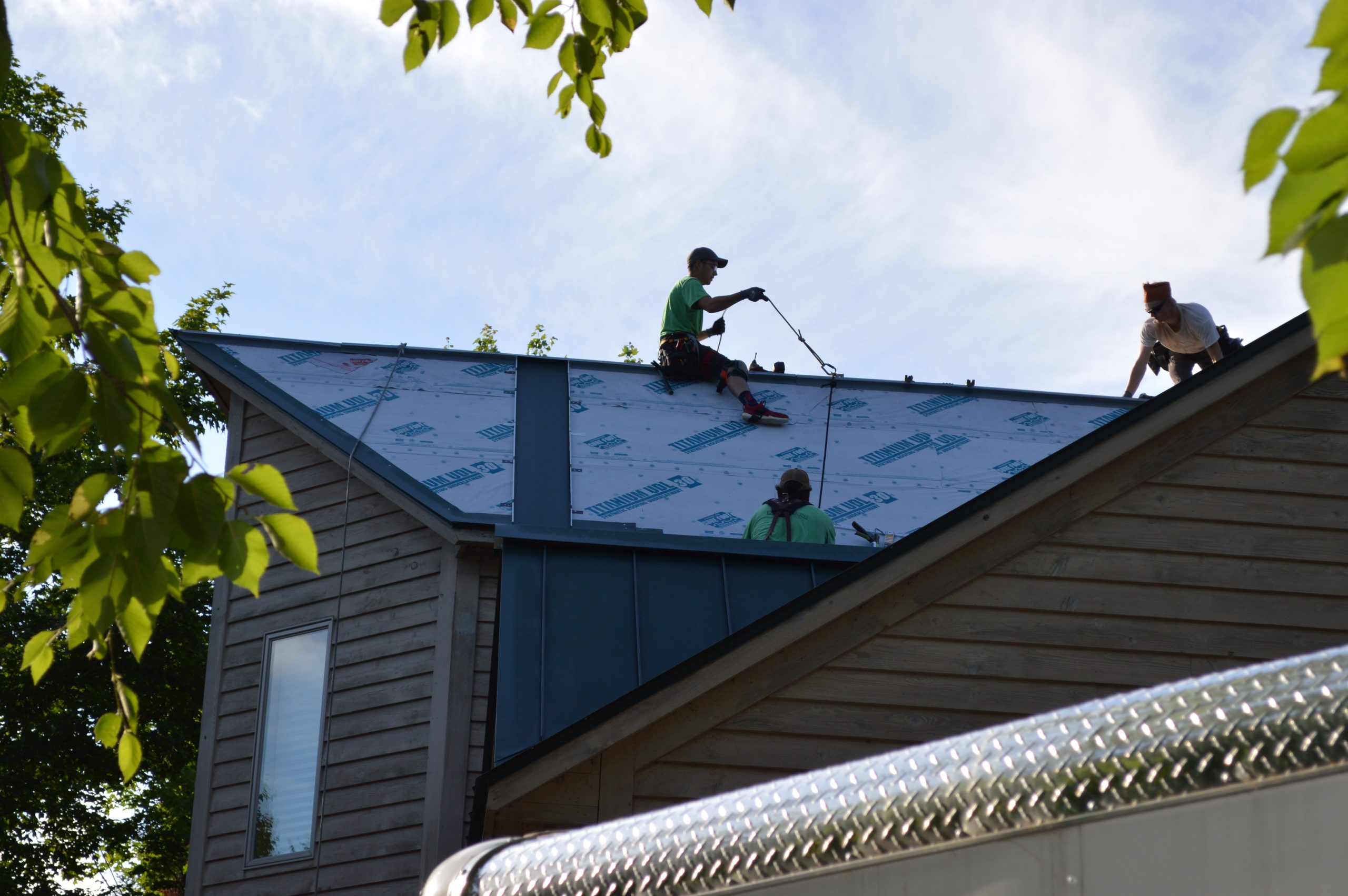

Originally Published as: Where Roofing Crews Lose Money: Labor cost doesn’t disappear at the estimate. It disappears after the bid wins and the crew is on the roof.
Open any growth guide written for roofing contractors this year and you’ll find the same ideas: better estimating software, sharper bidding tools, AI tools that show homeowners what the finished roof will look like. None of it addresses what happens on the job itself.
That’s not an accident. Pre-job tools are easy to sell because they’re easy to show. A bidding tool has a demo moment: type in a roof, get a number, the client approves it on the spot.

Field labor doesn’t work that way. There’s no visible payoff when a foreman’s hours get coded to the right job. No number changes on a screen, no confirmation the customer sees. So the tools that manage the bid keep getting attention, and nobody looks at what happens once the crew is on the roof.
The Math Nobody Runs
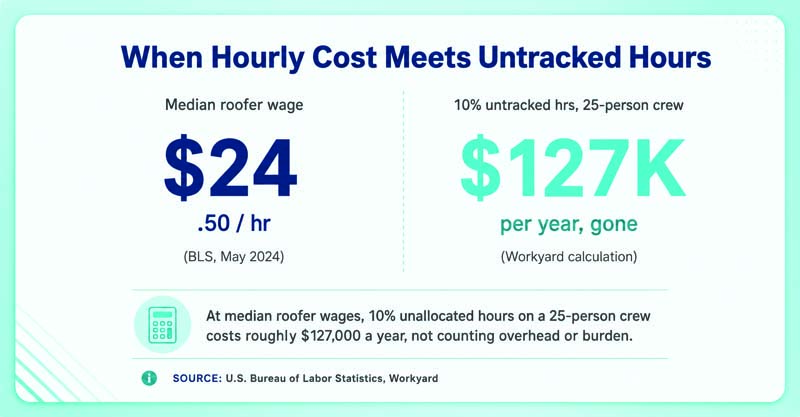
The U.S. Bureau of Labor Statistics puts the median roofer wage at $24.50 an hour.1 On a 25-person crew where 10% of hours go untracked, meaning no one can tie those hours to a specific job, that gap costs roughly $127,000 a year. As wages rise, that gap costs more every year.
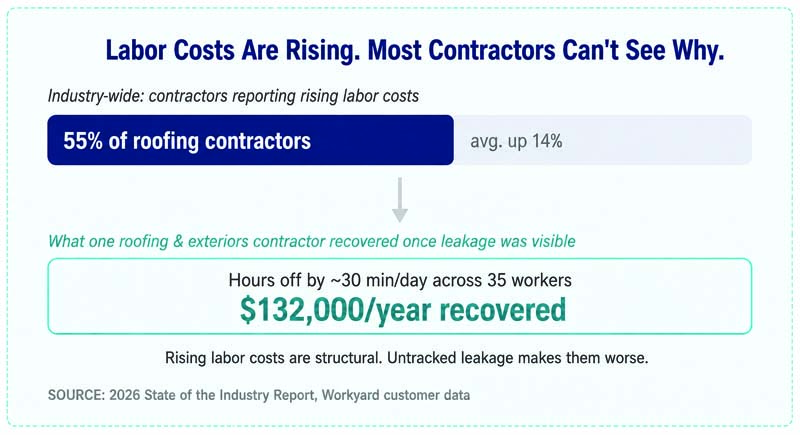
According to a 2026 industry report on roofing labor costs, 55% of roofing contractors reported rising labor costs this year, with the average increase running 14%.2
Rising wages make that $127,000 gap larger every year. When hours are still logged by memory or written down at the end of shift, contractors pay more for hours they can’t assign to a specific job or verify against their estimate.
Most contractors know their margins are tighter than they should be, but few can trace why.

What Leakage Looks Like in Practice
When I asked one general manager at a mid-size roofing and exteriors company how they found the gap, the answer was simple: they started tracking hours by job.3 They found hours were off by roughly 30 minutes a day across 35 workers. No single cause. Just rounding at the end of a shift, drive time between jobs that nobody logged, lunch that ran long. Add it up across a full year and that company recovered close to $132,000 once they started capturing those hours accurately.
With job-level data in hand, they could finally separate estimating problems from field execution problems. Some jobs ran over because they were being bid too lean on labor. Others ran over because of field habits that were easy to fix once visible: drive time that wasn’t being logged, shifts that ran slightly over without anyone recording the extra time. Before the data, both looked the same: lower margin than expected, with no obvious cause.
Any contractor running on blended margin numbers without job-level hour data is in the same position.
Visibility Changes More Than the Timesheet
Another roofing industry client located in the Pacific Northwest had the same problem show up in dispatch rather than payroll.4 The person managing their field operations described it directly: “I’ve saved a lot of time routing people by proximity and best-case scenario situations. I’ve never been able to do that before.”
Before they had GPS visibility into where crews were during the day, their dispatcher assigned jobs by routine, sending the same crew to the same area regardless of where that crew was actually starting from that morning. The result was unnecessary travel time baked into every day.
Once the office could see each crew’s real-time location, they assigned the nearest available crew to the next job instead. That change alone saved roughly 5,200 hours a year in travel time. At current 2026 labor rates, those 5,200 hours come to roughly $145,000 a year in recovered time.
The crew’s skill didn’t change; the season’s workload didn’t change. What changed was the information available to the person making the dispatch decision. GPS time tracking software is one way contractors are getting that information. But the tool is secondary. Contractors who track hours as work happens stop reconstructing them from memory after each shift.
The Part Nobody Demos
The reason job-level hour tracking stays on the to-do list is the same reason the growth guides don’t cover it: there’s nothing to show. A software vendor can demo an estimating tool in five minutes. Job-level hour tracking has no equivalent moment. It’s unglamorous work, which means it gets skipped until someone runs the numbers and realizes what it’s costing them.
Pre-job tools solve a real problem, and they deserve the attention they get. But an accurate bid only protects margin up to the point where the crew starts work. After that, the margin depends on whether the hours behind that bid are being captured by job, or whether they’re disappearing into a gap nobody has measured yet.
What to Check This Week
Pick one crew and one week. Compare the hours on the schedule against what was actually logged on-site, using whatever method you use now. If the two numbers are close, you’re ahead of most. If they’re not, you now know where to look, and you have a sense of what closing that tracking gap is worth.
Alexandra De Bonis is co-founder and Head of Product at Workyard [workyard.com]. Since co-founding Workyard, she has worked closely with thousands of construction professionals. Her focus is turning the everyday challenges faced by field teams and back-office staff into intuitive products that help businesses operate more efficiently and profitably.
Sources
1. U.S. Bureau of Labor Statistics. “Roofers: Occupational Outlook Handbook.” May 2024. https://www.bls.gov/ooh/construction-and-extraction/roofers.htm
2. Roofing Contractor Magazine. “2026 State of the Roofing Industry Report.” January 2026. https://www.roofingcontractor.com/articles/101643-2026-state-of-the-industry-report
3. Workyard. Customer proof point data, anonymized. Mid-size roofing and exteriors contractor; General Manager. Internal dataset.
4. Workyard. Accord Group case study. IT Business Relationship Manager, roofing and exteriors contractor. https://www.workyard.com