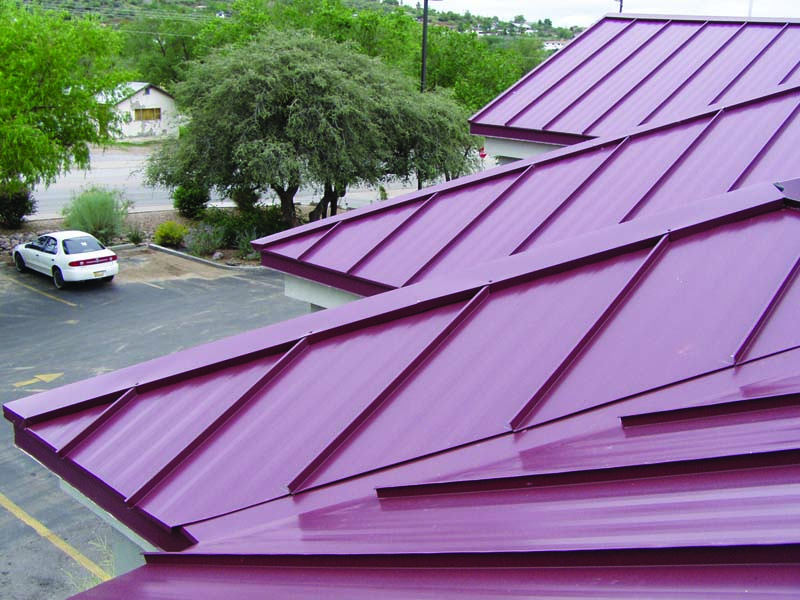
Originally Published as: Less stress = Less Oil Canning: Life ain’t easy being a metal roofing panel
OCTOBER/NOVEMBER 2006 FLASHBACK
Although published in 2006, Jim Austin’s article on oil canning remains highly relevant to today’s metal roofing professionals because it addresses a challenge that continues to affect standing seam installations. You’ll gain a practical understanding of the primary causes of oil canning, including uneven substrates, stress during roll forming, improper panel handling, fastening pressure, and thermal expansion and contraction. This article reinforces an important message: oil canning is typically an aesthetic issue, not a structural failure or product defect.
One of its greatest benefits is its emphasis on customer education and expectation management. Those who explain oil canning up front can reduce callbacks, disputes, and dissatisfaction—especially in today’s premium market, where homeowners expect both durability and visual appeal.
The article also provides practical strategies for minimizing oil canning. It further highlights the role of manufacturing quality, including coil handling, slitting precision, and roll former setup. Ultimately, this article reminds us that while oil canning cannot always be eliminated, it can be minimized through quality materials, skilled installation, and expectations managed through clear communication.
Becoming a standing seam metal roofing panel is stressful. Before it takes a recognizable shape, it is submitted to coating, slitting, coiling, and being bounced around by a forklift and in a delivery truck.
Then there’s the strain of forming. A flat piece of metal is manipulated through several stages of rollers to form a standing seam panel, complete with several bends of 90 degrees or more, and hopefully, a flat pan between.
After being formed, the metal roofing panels are cut, carried, lifted, and fastened into place. These panels may or may not be installed on a structure that is perfectly level or square. When installed on an imperfect substrate, the metal roofing panels may become twisted or buckled, because as one manufacturer representative reminds us, “Metal doesn’t stretch!”
However handled, formed, or installed, they are now metal roofing panels and are held to the highest of roofing standards. Those standing seam panels must be able to stand up to wind, rain, hail, fire, snow, sunshine, and anything else Mother Nature throws their way. And that’s not a problem. That’s what metal roof panels are manufactured to do.
Yet even after they are installed, metal roofing panels get no rest. They expand and contract. Any change in material temperature, no matter how minute, gradual, or drastic, keeps metal roofing panels on the move. That movement is known as thermal movement. Installed properly, allowing for thermal movement, metal roof panels will still do the job they were manufactured to do — provide cover for everything underneath.
In addition to providing an everlasting cover for the building, architects, homeowners, and building owners expect them to be aesthetically pleasing as well. That’s not a problem either, unless …
Any or all of the aforementioned stresses can induce what is referred to as oil canning. It appears in varying degrees and any number of sources can be held accountable for inducing those stresses. Few in the industry like to talk about oil canning because of its negative connotations. Unfortunately, not talking about it doesn’t make it go away. According to the Sheet Metal and Air Conditioning Contractors’ National Association, “oil canning is a perceived waviness of the flat areas of metal panels. It is a naturally occurring phenomenon that is inherent in all light-gauge sheet metal. Oil canning is more apparent under shallow cross lighting so its presence is more discernible during certain seasons or times of day. Also, differing forces can create waviness, either temporary or sustained, as the sun moves across the sky. Oil canning is an aesthetic issue, not a structural problem or defect. It is unrealistic to expect any architectural roof or similar element to be totally free of some degree of oil canning.”
A contractor who informs customers about the potential for oil canning, and does his best to minimize it, can reduce the chance of callbacks, panel replacement, and worse — not getting paid. Unfortunately, some argue that this educational conversation with the customer could point out a problem that may never be noticed without prompting. Either way, it’s very important to note oil canning will not affect the performance of a metal panel roof system.
“I don’t know if there is a surefire way to make sure that a panel is as flat as it can be,” says Ray Marcon of R.H. Marcon Roofing Contractors in State College, Penn. “What we do is try to educate the owner/specifier, etc., as to what the causes of oil canning are and what they should expect prior to the application of the metal. Painted metal and the architectural metals are different so we explain the patina development of the copper or terne-coated steel, and what to expect from the painted metal depending on sunlight, cloud cover, and time of day.
“As far as we are concerned, oil canning is inherent in sheet metal roofing and it is what it is.”
Are you fighting oil canning?
Even moderate oil canning has no effect on the performance of the roofing system, but most architects, homeowners, and building owners prefer not to look at it. And that’s not unreasonable, even though there are varying degrees of oil canning. That’s what has prevented anyone from establishing a standard of acceptance for oil canning — thus far. (Metal Roofing Magazine, August-September 2004.) Reputable installers and manufacturers would rather install metal roofing panels without oil canning and do their best to minimize it.
Brett Hall of Joe Hall Roofing in Arlington, Texas, says it is important to cautiously handle coil before panels are formed and to carefully transfer panels from the roll former to the roof line, making sure to have enough hands to reduce the possibility of panel stress. “Wind is the biggest enemy of standing seam installers,” he says. “The dedication of the workers to take their time and not get in a hurry at any point separates the best work from the rest. Time, attention to details, and a careful eye for measuring can mean more profits on beautiful architectural standing seam roofing.”
Again, metal roofing installers are craftsmen. There is some finesse involved for the proper installation of a standing seam roofing system.
“With a good deck, a good quality panel, and an installer with a soft touch, oil canning can usually be minimized,” says Jerry Iselin, owner of Metal Roof Specialties in Tacoma, Wash., and a regular speaker at METALCON International. “Notice I said ‘minimized.’”
That should be the goal. No one will claim to have an oil canning remedy, eliminating it altogether … well, almost no one. New Zealand native Pete Croft of Metro Roof Products, a manufacturer of stone-coated steel shingles offers this suggestion: “If you don’t like oil canning, throw some granules on it, mate!”
Because that is not an alternative everyone can live with, let’s investigate suggested methods of minimizing oil canning — without granules.
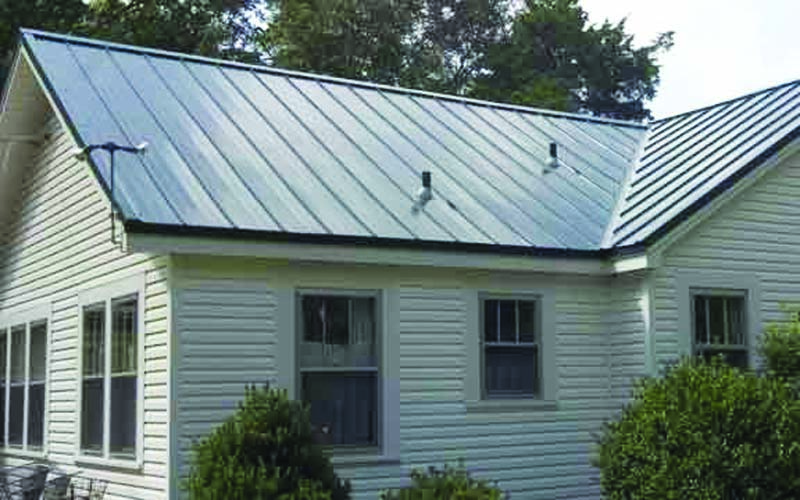
“Oil canning is a result of one or a combination of three conditions,” Iselin says. “Either a substrate is uneven, the panel has oil canning induced into it through the fabrication process, or the installer induced it through excessive force while attaching it. An uneven roof deck is usually the issue and unfortunately there is very little that can be done to correct it. The thought of installing shims or otherwise trying to even out the deck usually makes things worse.”
So what makes it better? For every installer of standing seam metal roofing panels, there is a method to or a theory on minimizing oil canning.
“We help alleviate oil canning by using 24-gauge metal,” says Lisa Brand of MasterCraft Metals in Tucson, Ariz. “We also run a series of three low-profile fluted striations in the panel. We only do standing seam, which allows for expansion and contraction better than a screw-down panel. A flat and uniform deck helps a lot, too.”
Almost every installer knows the deck can induce oil canning. Those that do all have their own theories and methods to work around the imperfect substrate.
“Most projects in our market are wood deck applications with no runners or hat channel,” says Hall. “Because of wood rafter evenness or unevenness, the substrate of the wood decking can undulate up and down. As the panel is clip-locked and fastened to this potentially uneven substrate, the formed steel panel will be stressed during fastening.”
Danny Boes of Southwest Metal Roofing Systems in San Antonio says minimizing oil canning is a top priority at his company and the occurrence of any oil canning shouldn’t come as a surprise to anyone when the job is completed. “It’s important to communicate with the customer about any imperfections in their roofline,” Boes says. “Any sagging or bowing will surely make a standing seam roof oil can.”
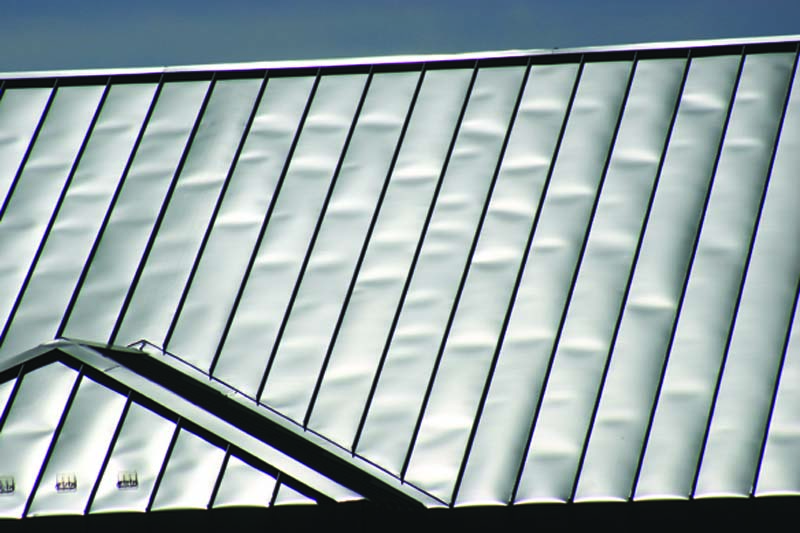
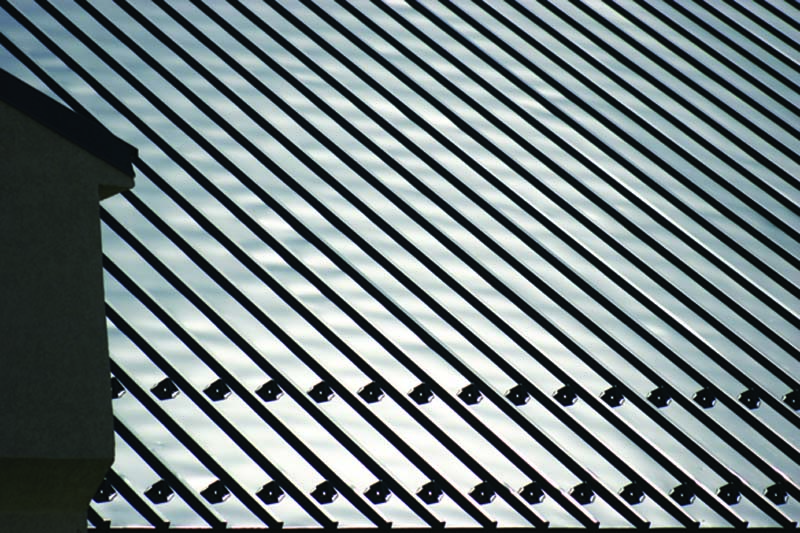
Problems with the deck were cited as one of the major culprits when it comes to oil canning, or telegraphing, defined as a distortion that may arise when a new roof is applied over an uneven surface. Unfortunately, most installers have minimal control over the construction of the deck. During the early stages of construction, or possibly during the bidding stages for a retrofit job, there should be a conversation about the importance for a level deck. It can be a greater problem when retrofitting older buildings or homes, where settling and rotted materials under the old roof could leave a less than perfect deck to install a new metal roofing system on.
“Educate yourself so that you can do the same for your client,” says David Mackey of Mackey Metal Roofing in Champlain, N.Y. “A frank discussion upfront can make a huge difference in the end. If installing over solid sheathing, make certain that the ice and water shield is properly applied so overlaps are clean and sitting down. Make certain the roof deck is as level as possible. Humps and dips will put stress on panels and accentuate oil canning.”
Beating the Deck
Even with an imperfect substrate — and you know at some point you’re going to run into an imperfect substrate — there are ways to minimize oil canning.
Many manufacturers offer profiles with striations or rib stiffeners to make the panel stronger and eliminate wide flat areas that more easily showcase oil canning. Oil canning may still exist in striated panels, it’s just lost in the striations. The angle from which the roof is viewed can be a factor as well.
“Slope plays a role,” Mackey says. “The lower the slope the more accentuated the oil canning. Try using a profile with stiffening ribs for lower slope jobs.”
Terry Lamb of Sunshine Metal Works in Oxford, Ala., also suggests using a panel with minor ribs or striations. “If you must use a flat pan, get a 24-gauge 12-inch pan to minimize oil canning,” he says.
Gauge is a major consideration, according to many installers and manufacturers. “Gauge alone is not enough to win the war, but it does play a role,” says Mackey.
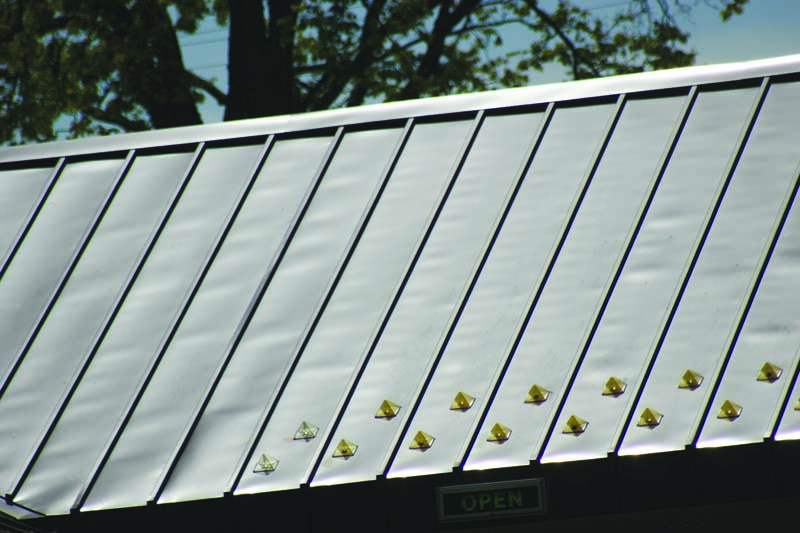
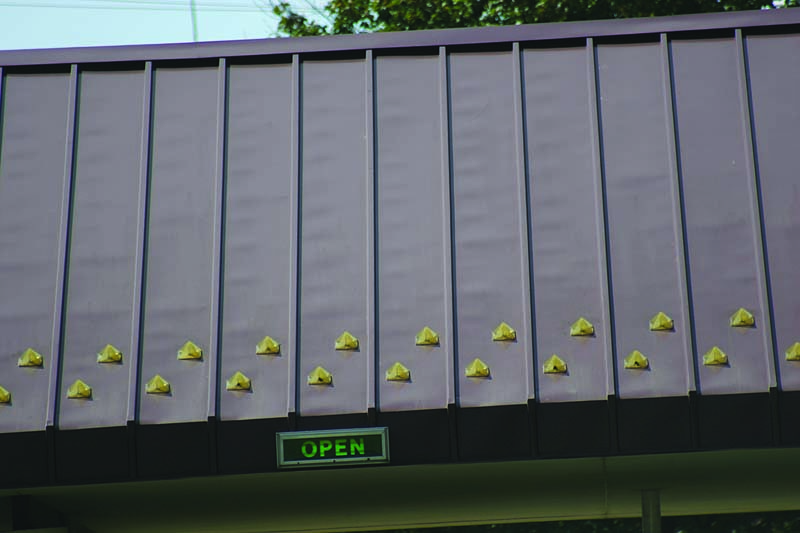
It makes sense that a heavier panel, no matter what metal, is going to be stronger and more resistant to oil canning. It’s an extreme example, but think about how easy it is to wrinkle aluminum foil.
“We will normally use heavier gauge zinc if oil canning is an issue,” says Jim Dallman of Rocky Mountain Architectural Metals in Carbondale, Colo. “We will use 18-gauge zinc if we think it’s necessary, but mostly we use 24-gauge or 22-gauge.”
Copper and zinc panels, obviously unpainted, have been in use for centuries as a roofing material. Minimal oil canning is sometimes more acceptable in panels manufactured from zinc or copper because their appearance is always changing, until they achieve the natural patina look each is famous for.
Modern roll forming equipment and mechanical seamers have allowed for the manufacturing and seaming of panels that run in excess of 100 feet. There was a time when 10-foot panels were hand-formed and hand-seamed. Some installers still do it that way when working with specialty metals.
“I always use the appropriate length panel — never more than 10 feet long with softer materials like copper and zinc,” says Mike Winters of Mike’s Metal Works in Bozeman, Mont. “I also over-bend the standing seam legs so that when they are seamed together they create a slight crown in the panel. This keeps the oil canning out and prevents substrate telegraph.”
Finesse in Installation
Carelessness during the installation process also can lead to oil canning. Including the careful handling of panels, the installer must have a full understanding of the system. “The installation is also key to the success of the finished product and depending on whether the panel has an independent clip or incorporated attachment flange product will have a definite impact,” says Iselin. “The clip systems are a little more forgiving as long as the clip is installed in line with the panel while the attachment flange products are a little more sensitive to the amount of pressure applied to the fastener and the stability of the substrate.”
Some installers believe that the more torque applied to a fastener, the better. That’s not true when it comes to aesthetics. And each attachment system is different and the installer should know the difference.
• Snap-lock or nail-strip panels are attached through slots in the male leg, allowing the panel to move the length of the slot — if the fastener is placed in the center of the slot and not so tight that it restricts movement.
• Single lock and double lock systems allow limited panel movement around the fixed clips.
• For longer runs, sliding clips provide the ability to accommodate expansion without damage to the panels.
“Allow for expansion,” says Sean Crocker of Crocker Architectural Sheet Metal of North Oxford, Mass. “Keep in mind what material you are using and how much it expands. Allow for your expansion with expansion cleats or fasteners. And pay attention to the time of year you are installing. In hot weather, you can be tighter than cold weather.”
It’s a safe bet you can learn from every installation, so experience is the best teacher. But every suggestion from an experienced installer has got to help.
“Buying from a quality manufacturer with modern computerized slitting machines really cuts down on oil canning as well,” says Boes.
Help is Available
Manufacturers are willing to help with oil canning issues, if they can. Many offer suggestions on their websites. Just like contractors are trying to install a metal roofing system with a minimal amount of oil canning, manufacturers are trying to supply contractors with the best metal and best roll formers to produce panels with minimal oil canning.
Since 1985, Englert has recommended their installers use backer rods in standing seam roofing where oil canning is a concern. Kevin Corcoran, vice president of business development at Englert, says the company made the switch to all low gloss paint on January 1, 2004 to combat the issue of oil canning. According to the Metal Construction Association’s Technical Bulletin on oil canning, “an embossed surface or a surface painted with a low gloss paint system will also help reduce visible waviness in the metal.” Paint companies offer “cool” paint systems that decrease the amount of thermal movement in a roofing panel because the temperature of the panel does not rise as high, reducing the stress that can create oil canning and actually increasing the life of the panel. Englert, like most manufacturers, also provides various profiles with striations or ribs.
RHEINZINK America national training and sales manager Kevin Wohlert recommends the company’s products be installed over Enkamet, a slip sheet, capillary break, and drainage space for the underside of the zinc. “In the past, I have used various methods from stiffening ribs to striations in the panel to minimize or hide the oil canning,” Says Wohlert. “In a façade application on shorter panels, sometimes we used to slightly cross-break them from corner to corner, creating an X in the face of the panel to stiffen it and reduce or eliminate oil canning.”
On its website, the Garland Company says to limit oil canning to a minimum, it designs roofing systems with unlimited thermal movement, using high quality roll forming equipment, and adds mechanical finishes to metal roof panels and accessories.
Follansbee takes a proactive approach on its website, stating “the architect should be aware that minor surface deflections known as oil canning are inherent in thin sheet metal skins. Factors such as reflectivity will amplify the oil canning appearance until painted. Also, wide flat surfaces will show deflections readily. Oil canning does not affect the finish or structural integrity of the panel and is, therefore, not cause for rejection. Oil canning induced from buckling stresses, however, should not be allowed. These are normally a result of improper application.”
The Copper Development Association offers the following suggestion: “If aesthetically objectionable, oil canning may be minimized by the use of expansion cleats, and by limiting the use of fixed cleats to pans 10 feet maximum in length. Fixed cleats should be installed at the midpoint of the respective pan in the pattern indicated.”
Just minimize it
It’s easy to say, “oil canning is inherent to light-gauge metal and therefore not a cause for rejection.” Reputable installers are doing their best to minimize oil canning, not hide behind a statement for their shabby workmanship. They owe it to their customers, to their business, and to the industry. Just like they work hard to install a roofing system that doesn’t leak, they work hard to install a roofing system that maintains curb appeal with as little oil canning as possible.
The key to the continuing growth and success of the metal roofing industry is performance, and like it or not, aesthetics have become as much a part of performance as preventing water infiltration. Manufacturers have worked hard to develop products that perform as attractive watertight metal roofing systems, including providing assistance for those willing to ask. The same goes for the manufacturers of portable roll formers — durability and beauty go hand in hand in the manufacturing of panels on the jobsite.
It’s what customers are demanding — customers who have opted to pay 2-3 times more for their metal roof than a lesser product. As far as they’re concerned it’s part of the deal. They’ve been sold on looks as well as durability.
Therein lies the challenge for everyone in the industry. Bad news travels faster than good news, especially when a dissatisfied customer is the bearer of bad news. And it doesn’t matter what the problem is, bad leaks or bad looks.
Metal roofing installers are working with the best roofing systems available and they need the best installation available. Most metal roofing installers understand this.
One installer told us, “It may not be easy, but if we wanted easy, we’d all be installing 10-year asphalt shingles.”